
AI shopping · x401 explained
AI agents can now pay for things?
An AI can find your next pair of shoes. But how does the store know you actually told it to buy them? Proof's x401 is trying to answer that question.
An emerging protocol—not a promise that every retailer supports AI checkout.
Watch the explainer
The hard part is permission.
My running-shoe example: “Find the best pair under $150 and buy them.” Comparing shoes is one job. Proving who authorized the purchase—and how far that permission goes—is another.
Why it matters
Not just “what can AI do?”
What is it allowed to do?
An assistant that recommends a hotel is useful. An agent that books it needs a trustworthy connection to your approval. These are the questions I want answered before it spends my money.
Who is behind the agent?
A store needs more than an AI saying it represents you. The missing link is verifiable human identity.
What did you approve?
Finding a product is not permission to buy it. A signed mandate is meant to connect your approval to the agent's action.
How much can it spend?
A budget should be a boundary, not just a suggestion in a chat. The video explores amount limits and narrowly scoped permissions.
Where can it shop?
Permission can be specific to a merchant and action, rather than ongoing access to every store.
When does access expire?
One purchase or a short time window is very different from handing over permanent buying power.
What can the store verify?
The goal is a checkable chain from human to mandate to agent, with evidence tied to the transaction.
How it works
A chain from you to checkout.
Think of it as a digital ID plus a tightly written permission slip. This is the proposed flow, not a setup you can switch on in every shopping app today.
Step 01
Start with a verified person
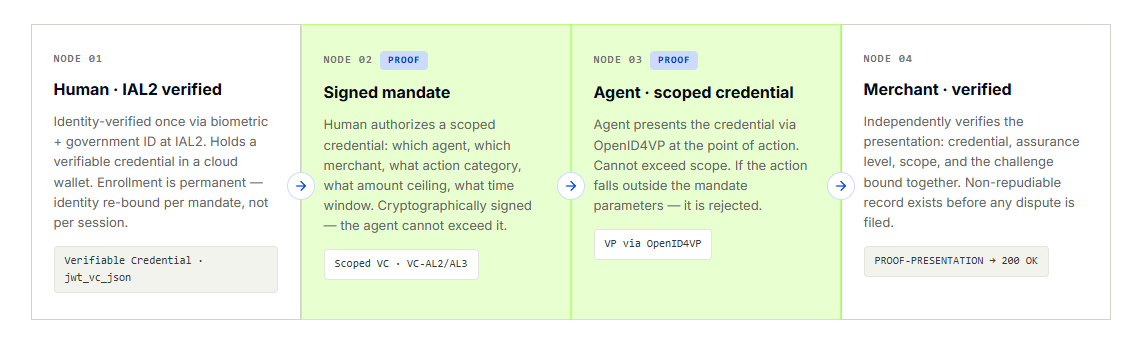
Proof's supplied diagram begins with an IAL2-verified human. In plain English: verify the person behind the request, not just the software arriving at checkout.
Step 02
Give the agent a narrow mandate
The person authorizes a specific agent, merchant, action, amount ceiling, and time window. The intended result is a signed permission that the agent cannot simply rewrite.
Step 03
Let the merchant check the proof
At the point of action, the agent presents a scoped credential. The merchant independently verifies the identity and authority chain; an action outside the mandate is meant to be rejected.
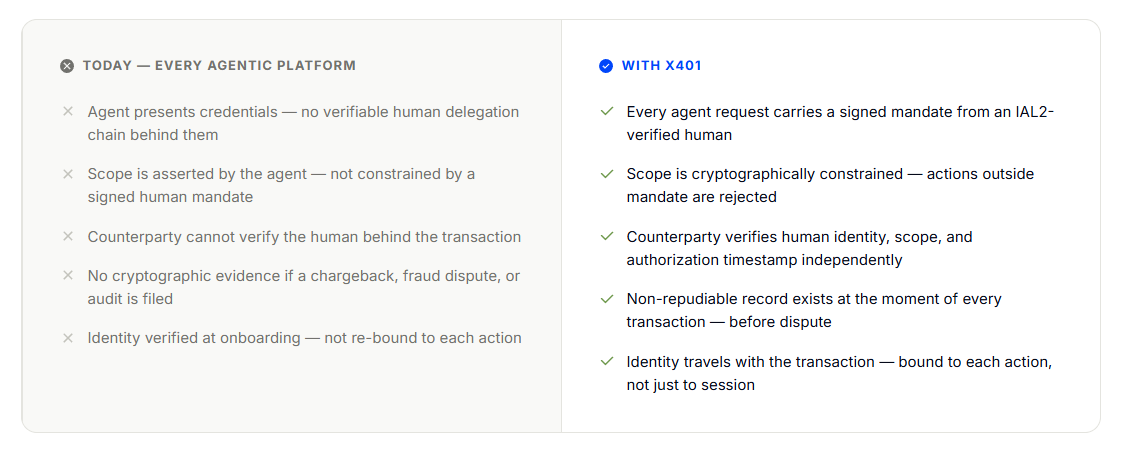
The proposed difference
A claim of permission versus proof of permission.
Proof's comparison describes signed, scoped authority tied to each action. Read it as the protocol's intended design—not independent evidence that every other agent platform lacks safeguards or that x401 eliminates disputes.
Every action needs an authorization trail.
Supporting clip supplied with the video.
What this doesn't establish
In the video, I use the Amazon/Muse shopping dispute as context. The takeaway is the authorization problem—not a claim that Amazon now accepts x401. A verified mandate also does not guarantee a good purchase, a refund, or a successful payment.
My view: giving agents secure, limited authority may matter as much as making them smarter. Adoption by real agents and retailers is the part to watch.
Before an agent buys
Keep the permission smaller than the task.
Set a total budget including fees, limit the merchant and item, prefer one purchase, and know how to revoke access. Save the checklist before trying any agent-shopping service.
This checklist is not a payment authorization or an x401 installation guide. Never paste card details, passwords, or identity documents into an ordinary chat.
Would you trust an AI with your money?
Tell me what limits you'd want in the video comments. I share the AI tools and changes I'm exploring in everyday life.
Read the primary sources
The explanation above follows my video and supplied diagrams. For the current protocol details, check Proof's own documentation.
More from Chad
Keep exploring
- Visit page
Tesla Light Show Generator
Turn any song into a Tesla light show with AI — no xLights required.
- Visit page
Is Paying for AI Worth It?
Honest review of Claude Pro, Copilot, Google AI Pro, and Lovable.
- Visit page
Claude AI for Beginners
7 mistakes I made with Claude so you don't have to — better prompts from day one.